Many mainstream dating apps allow high-volume or effectively unlimited liking, particularly through paid tiers, and even where free users face daily limits, the receiving side still gets crowded, because popular profiles can accumulate far more attention than they can realistically review. Likes become cheap, a few inboxes overflow, and the average person's like disappears into the noise. Agilis takes the opposite approach: you can hold at most ten likes at a time. There's a simple mathematical case that this stops your like being buried, and improves the chance it's actually seen and considered.
How the ten-like limit works #
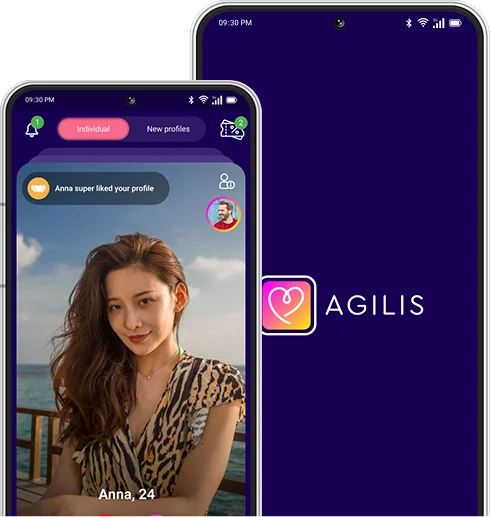
On Agilis you can have up to ten likes out at any moment, so each one is a deliberate choice rather than a reflex. The limit works on the receiving side too: once someone has ten likes waiting, their profile is marked as Taken until they've worked through them. That means you're never pouring likes into an inbox that's already full. You can see at a glance who genuinely has room to meet someone new.
The maths of a like that competes with hundreds #
Start with the basic quantity that matters to you as a sender. Suppose the person you like has L likes waiting and engages with k of them. In a simplified model where each waiting like has an equal chance of being chosen, the probability that yours is among the k considered is k divided by L. Real behaviour is not equal-chance (photos, compatibility, timing and ranking all matter), but the model isolates the variable that platform design controls: how big L is allowed to get.
In a high-volume liking system, L is effectively unbounded, and the evidence is that attention accumulates very unevenly. A large-scale study of heterosexual online dating in four US cities, published by Bruch and Newman in Science Advances in 2018, found a pronounced hierarchy of desirability and showed that users tended to contact people around 25% more desirable than themselves by the study's measure, with the effect that first messages funnelled towards a small fraction of highly sought-after profiles; the most contacted user in the study received over 1,500 messages in a month. One often-cited (though non-peer-reviewed) analysis of swipe-app data estimated a Gini coefficient of 0.58 for the distribution of likes, a figure that should be treated as illustrative rather than definitive, given its small self-reported sample, but which points the same way. The shape of attention is long-tailed rather than bell-shaped: a few profiles hold enormous queues, while most hold very little.
Put numbers on it. In a pool of 1,000 active users where the average person sends 50 likes, 50,000 likes are in circulation. If the most-liked tenth of profiles absorb half of them, a typical profile in that group holds around 250 likes. Suppose they engage with five. Under the equal-chance model, your probability of being among them is 5/250 = 2%. And the problem compounds with scale: queue depth for popular profiles grows roughly in proportion to the number of active senders N, so the chance your like is even seen shrinks as the platform grows. On a large high-volume platform, your like usually isn't being rejected; it's simply never being considered.
The same maths with a cap of ten #
Agilis changes one variable: L is capped at 10 for every profile, because the eleventh would-be liker sees a Taken badge instead of a like button. Substituting into the same simplified model, your probability of being among the k likes a recipient engages with is k/L ≥ k/10: under the equal-chance assumption, at least 1 in 10 even if they match with only one person. Your real chance with any individual still depends on compatibility, as it should. But the deeper point doesn't depend on that assumption at all: the queue-depth problem is capped at ten. A queue of ten is small enough to review in full, so your like is always among the at most ten in front of them. What the cap guarantees is visibility, not romance.
The crucial mathematical property is that this visibility bound is invariant to scale. In the unbounded model, your like's share of a popular profile's attention shrinks as the platform grows; in the capped model, the bound doesn't contain N at all. Whether Agilis has ten thousand users or ten million, a like you send can never be buried below position ten in anyone's queue. There’s also a redistribution effect: the likes that would have been the 50th or 200th in a popular profile’s pile can’t be sent while that queue is full, so some interest is redirected towards profiles with capacity rather than being endlessly added to the already-oversubscribed few.
The cap disciplines senders as well as protecting recipients. In the language of signalling theory (the economics of how costly choices convey information, formalised by Michael Spence in the 1970s), a like drawn from a budget of ten is a costly signal: spending one communicates genuine, considered interest precisely because it couldn't be sent to everyone. A like from an effectively unlimited supply carries almost no information; a like that consumed a tenth of your budget carries a great deal. These are stylised models rather than measurements, and real behaviour is messier, but the structural conclusion doesn't depend on the exact numbers. Bounding the queue at ten stops your like being buried, and that is what makes every like on Agilis worth sending, and worth receiving.
Jehan Rajendra
Founder, Agilis Building a 100% free dating app because meaningful connections shouldn't sit behind a paywall. Writes about safety, privacy and the product decisions behind Agilis.
Profile