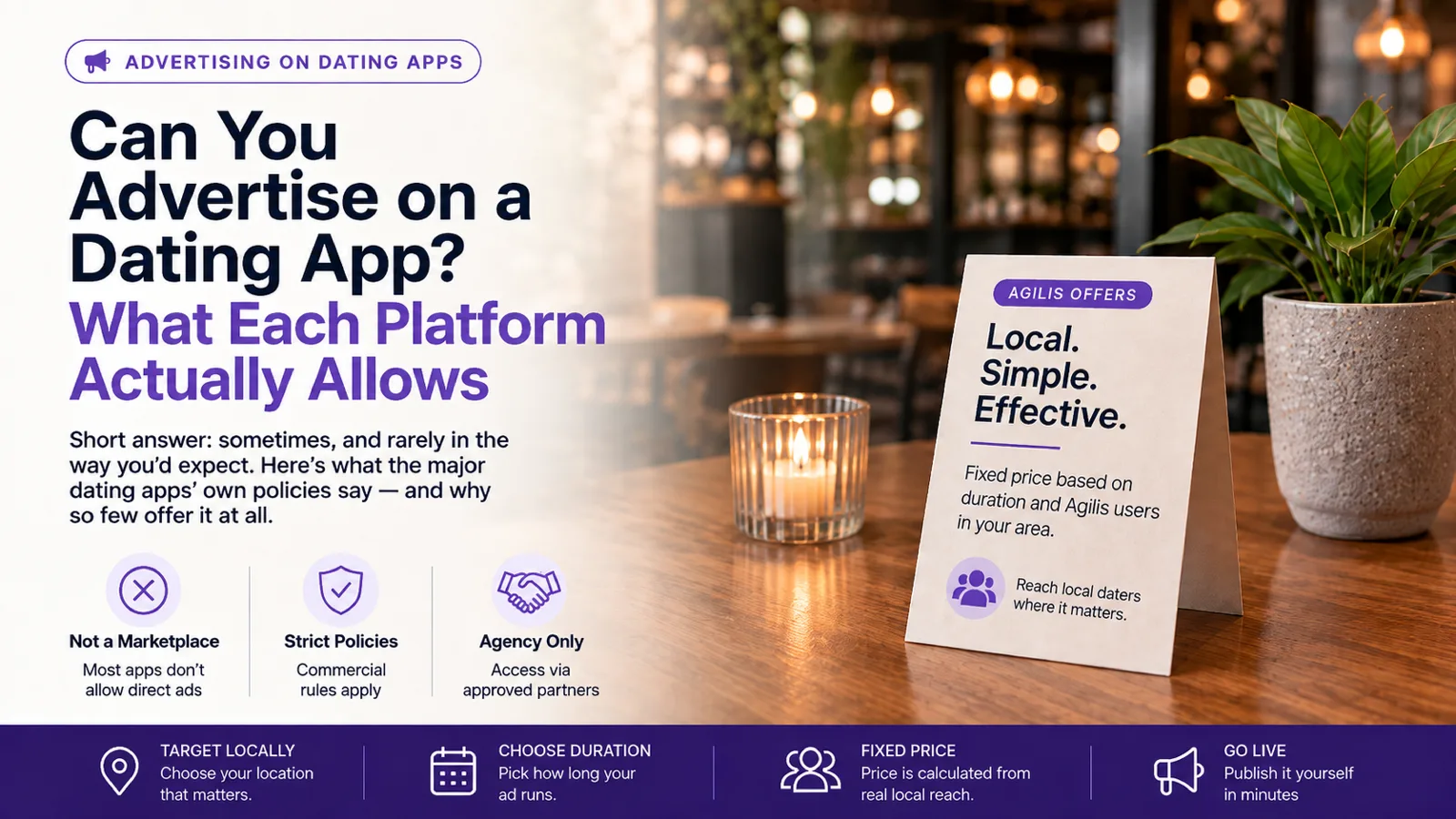
Can You Advertise on a Dating App? What Each Platform Actually Allows
Short answer: sometimes, and rarely in the way you'd expect. Here's what the major dating apps' own policies say about running ads on them — and why so few offer it at all.
If you run a bar, a restaurant, a salon or an events venue, dating apps look like an obvious place to advertise. The audience is local, it skews to people actively planning to go out, and they are on their phones deciding where to go.
So it comes as a surprise to most business owners that the answer to "can I advertise on a dating app?" is usually no — or at least, not directly, and not by yourself.
It's worth understanding why, because the reason is structural rather than accidental.
Taking them in turn, based on what each company publishes.
Bumble is the most explicit. Its community guidelines on commercial and promotional activity state that Bumble "is not a marketplace, and using the platform for unsolicited commercial or promotional purposes is not allowed". That is a rule aimed at users promoting businesses through their profiles, and there is no self-serve advertising product for businesses either.
Tinder and Hinge don't operate open self-serve ad platforms in the way Google Ads or Meta do. Placements on them are generally bought through third-party media marketplaces and agencies — The Media Ant, for example, sells Hinge placements and quotes rates on request. In practice that means a minimum spend, a sales conversation and a lead time, which puts it out of reach of most independent venues.
Facebook Dating sits in a different category again, because it lives inside Meta's advertising system. Meta's own policy is that ads for dating services "are only allowed with prior written permission", and once granted, those ads can only target people 18 or over and must follow Meta's dating ad guidelines.
Most large dating apps don't earn their money from advertising. Match Group, whose portfolio includes Tinder and Hinge, tells investors its revenue comes primarily from users directly through recurring subscriptions and à-la-carte purchases, reporting around $3.5 billion in direct revenue in 2025. Bumble's own annual report describes a freemium model in which a subset of members pay for subscriptions or in-app purchases, and states that advertising and partnership revenue are not a significant part of the business.
If subscriptions are the business, advertising is a distraction. It adds clutter to a product you are trying to persuade people to pay for, it requires a whole sales and moderation operation, and it earns a fraction of what a subscriber earns. The rational decision is not to bother — or to sell inventory wholesale through an agency and avoid building anything self-serve.
Dating is a regulated advertising category, and that applies whichever route you take.
Google's advertising policies treat dating and companionship as a restricted category: some kinds of dating ads, including matchmaking and dating facilitation, are permitted only where they comply with its specific policies, and advertisers may need certification. Meta requires written permission before dating ads can run at all. In the UK, the Advertising Standards Authority publishes guidance for dating services covering how they may be promoted.
Note that these rules govern advertising a dating service. If you are a restaurant advertising inside a dating app, they generally don't apply to you — but the app's own advertising standards will, and any responsible platform will review what you submit.
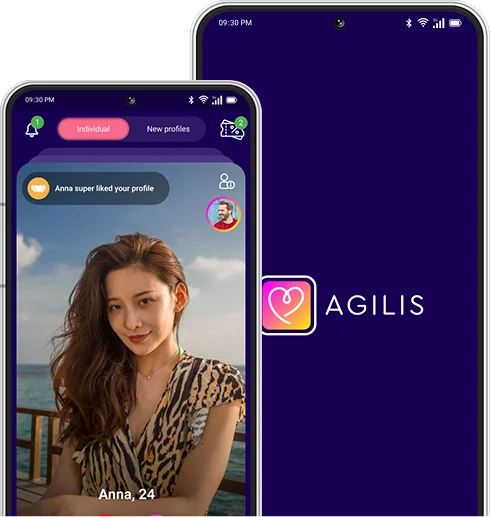
We built Agilis without subscriptions, which means advertising isn't a distraction from our business model — it is our business model. That changes the incentives entirely.
So we did build the self-serve product: local businesses can create an account, register their organisation, and set up an offer targeted to a chosen area, with dates and a budget they control. Pricing is fixed and visible before you commit — calculated from the campaign duration and the number of Agilis users in the area you're targeting — rather than quoted on request.
There is no minimum spend that rules out a single venue, and no agency in between. You can see how it works and what it costs on our advertise with Agilis page.
That isn't a claim to be better than a platform with a hundred times our audience. If you need national reach tomorrow, a large network will serve you better. But if you want to reach people near your venue who are actively planning to go out, and you want to do it without a sales call, the options are narrower than you'd think.
Whichever platform you consider, a few questions save a lot of time:
Can you actually buy it yourself, or does it require a sales conversation and a minimum spend?
Do you know the price before you commit, or is it quoted on request?
How precisely can you target by location — city, postcode, radius?
Can you pause, edit or cancel once it's live?
What reporting do you get, and how soon?
Is the audience actually relevant to what you're selling?
That last one matters most. A dating app audience is a good fit for venues, experiences and things people do on a night out. It is a poor fit for plenty of other businesses, and no amount of targeting fixes a mismatch.
Jehan Rajendra
Founder, Agilis
Building a 100% free dating app because meaningful connections shouldn't sit behind a paywall. Writes about safety, privacy and the product decisions behind Agilis.
Profile